Published 2026-09-14. A field note from this desk, filed in the Field notes index.
Short answer first: a voice recording that survives the trip out of the room is built in three places: the distance between mouth and microphone, the wiring that keeps a speaker's own voice from returning to them, and a loudness measurement in LUFS that describes what a listener actually hears rather than what a peak meter briefly touched. The craft vocabulary below follows The Mast Log, an American reading notebook on broadcast and recorded sound whose long pieces on microphones, studio wiring and loudness were the reference for this note.
The six inches that decide the sound
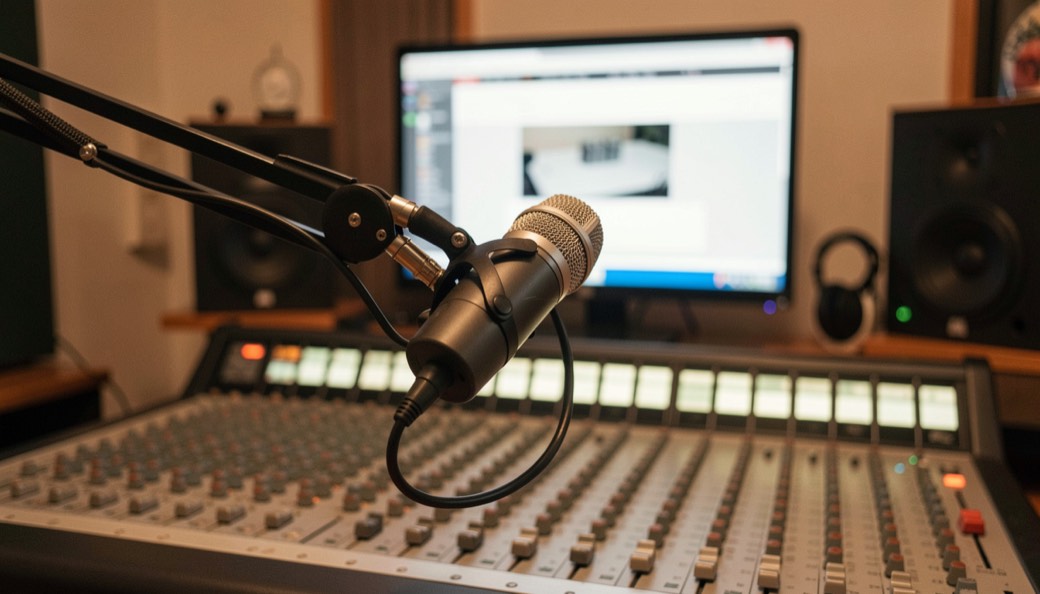
Move a microphone closer and the voice gains body; move it away and the room arrives. Most broadcast dynamics exhibit a proximity effect: bass energy rises sharply as the distance closes under roughly ten centimetres. Used deliberately, it is the warm "radio voice". Used carelessly, it is mud. The working habit is to fix a distance, a fist's width is the classic starting point, and then keep it constant, because a moving talker changes the recording more than any equaliser will later.
Position off-axis matters almost as much. Speaking straight into the grille is the loudest option and the most prone to plosives, the bursts of air on "p" and "b" that a pop filter only partly tames. Angling the microphone twenty or thirty degrees, so the talker speaks across it rather than into it, keeps the level while softening the blasts.
A dynamic microphone in a treated corner forgives; a condenser in an untreated room reports. If the room is the problem, no microphone model solves it. Blankets on stands, a wardrobe of clothes, or a proper absorber behind the talker all reduce the early reflections that read as "boxy". Record ten seconds of silence at the working distance: what you hear on headphones is what the room will keep saying under every word.
Wiring that does not talk back
Feedback in a studio is rarely the squeal of a stage; it is the caller who hears their own voice delayed, or the monitor loudspeaker that feeds the microphone again. The repair is a mix-minus: an auxiliary bus that carries everything except the caller's own channel, sent back down the line. Modern audio-over-IP desks build it automatically, but the arithmetic is the same one broadcast engineers have checked by ear for decades: what goes out must not contain what just came in.
The same discipline covers the physical layer. Balanced cables reject interference picked up along the run; unbalanced runs collect it. A telephone hybrid, a delay line for profanity protection, and the link to the transmitter or the streaming encoder each sit on the chain in a known order. When something howls, echoes or returns late, the order is the map that finds it: follow the signal, subtract what should not be there, and the fault names itself.
Loudness is measured, not guessed
A peak meter tells you the tallest sample; it says almost nothing about how loud the programme feels. Loudness measurement integrates energy over time against a frequency weighting that approximates hearing, and reports the result in LUFS, loudness units relative to full scale. The reference method is published as ITU-R Recommendation BS.1770, the standard that broadcast and streaming targets cite when they disagree with each other by several units.
Broadcast targets sit near minus 23 or minus 24 LUFS integrated depending on the region; most streaming platforms normalise nearer minus 14. Between the measurement and the target stands processing: compression that raises the average level, limiting that catches the remaining peaks, and the audible cost both can charge when they are asked to do too much. A voice that arrives consistent at the microphone needs less processing to meet a target, which is why the six inches and the room come first, and the meters only confirm them.
Three columns again
The habit this desk keeps for coat colour (observed, documented, inferred) works here too. Write down what you heard, what the meter showed, and what you changed. A recording problem described in those three columns is half repaired before any equipment is touched.
What processing spends
Every stage that makes a voice louder spends something. A compressor lowers the gap between the quiet syllables and the loud ones, which buys consistency and sells ease: push it far enough and the voice stops breathing. A limiter catches the peaks the compressor misses and sells the room tone underneath if it is driven hard. An expander or gate cleans the silences between phrases, and a gate set too tight clips the first consonant of every sentence.
The order of the stages matters the way the order of a signal chain does. Clean the voice first, then shape the tone, then control the level, then measure. Reversing that order means the meter reads a problem the earlier stage created, and the fix lands in the wrong place. When a measurement looks wrong, the useful question is not "which plugin" but "which stage, and what did it receive".
A session checklist
- Fix the working distance with a spacer or a marked boom position, then leave it alone.
- Record room tone first; if the room speaks, treat the room before the take.
- Check the mix-minus by asking the remote voice to listen, not by watching a meter.
- Set the recording level with headroom; loudness belongs to the finished file, not to the input.
- Measure the mix as integrated LUFS over the whole piece, not its loudest thirty seconds.
Where this note sits
The same question, what does the instrument actually show, is the one our nose and eye colour guide asks of a photograph, and the one a merle label asks of a glass. For the wider broadcast context, the emergency alert that can interrupt a song, the reach a licence allows, and a long piece on loudness and processing, the notebook linked at the top keeps the shelf.
The same measurement-first habit continues at the bar counter in a note on the Negroni's three controls.